

PET bottle chip: Why are China domestic and export spreads diverging so sharply? |
|
| Amber | |
| Insight | Time: Nov 20 2026 2:13PM | |
Recently, market observers may have noticed a clear divergence between China domestic and export processing spreads for PET bottle chips. Take November 19 as an example: for East China water-grade bottle chips and the FOB Shanghai export price index, calculating based on RMB and USD feedstock costs respectively, the domestic RMB processing spread reached 443 yuan/mt, while the export USD spread climbed to $170.6/mt (approximately 1,145 yuan/mt based on the USD/CNY central parity rate of 6.71). Is this because export selling prices are significantly outpacing domestic prices?
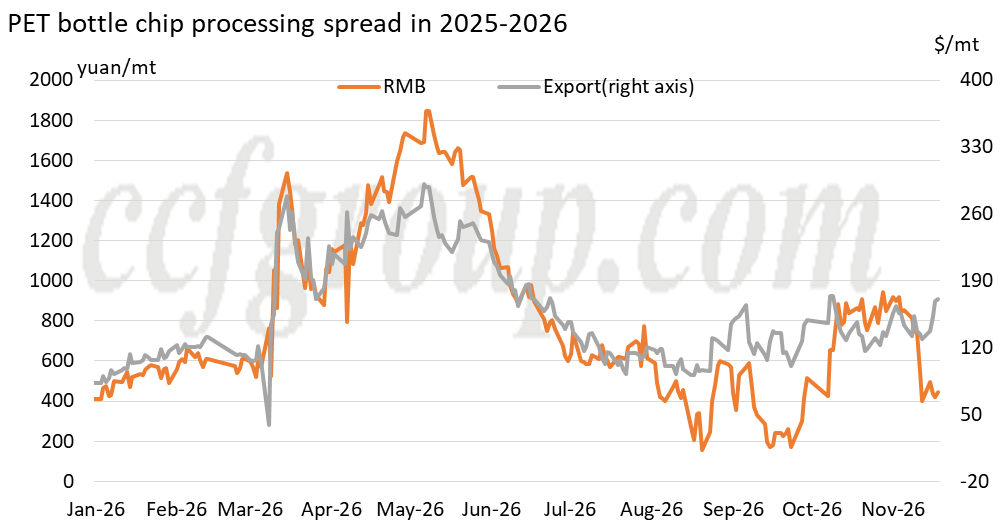
First, it should be pointed out that a misconception exists here. CCF's RMB feedstock PTA and MEG price assessments are based on transactions with delivery periods within the most recent two weeks, whereas the USD PTA and MEG price assessments cover orders delivered within two months. Under normal market conditions, there would not be a significant premium or discount between RMB and USD feedstocks. However, since this year, the Middle East conflict has drastically reduced transit efficiency through the Strait of Hormuz, compounded by concentrated shutdowns and production cuts at upstream feedstock units. USD feedstocks, especially MEG, at one point had almost no spot cargo available for negotiation, while forward contracts carried significant discounts to spot. China domestic RMB feedstock spot prices saw premiums at one point exceeding 1,000 yuan/mt. This has caused a significant deviation in feedstock costs and processing spreads calculated using RMB versus USD indices.
Second, China domestic bottle chip plants have consistently used spot feedstock indices to settle immediate costs, whereas the delivery cycle for bottle chip export orders is typically longer. Aside from small and medium-sized orders, which are mostly within one month, most long-haul orders take two months or more. When concluding orders, enterprises do not immediately purchase feedstocks in the spot market; instead, they use futures tools or forward contracts to lock in future feedstock costs, especially against the recent backdrop of sharp spot feedstock premiums. Once the export order selling price is determined and feedstock costs are locked in via forward arrangements, the processing profit for that order is largely fixed at the moment the order is concluded. If the enterprise anticipates feedstock prices will decline or remain rangebound going forward, this forward pricing model can effectively hedge against cost shocks from short-term spot market surges, thereby preserving or even expanding export profits.
It should be noted that this accounting appearance of better export profits does not fully equate to higher actual net profits from export business. Additional costs in the export process (such as ocean freight volatility, anti-dumping duty rates, etc.) must also be considered. Furthermore, if forward-priced feedstocks see sharp declines in the subsequent market, export orders may also face the problem of having locked in costs at a relatively high level.
In addition, based on recent market performance, constrained by supply and high local prices, overseas customers are indeed more willing to accept higher selling prices, and profits are indeed relatively better than domestic sales. The domestic-export price spread can basically be maintained at 200–300 yuan/mt or above, but absolutely not as exaggerated as the nearly 700 yuan/mt gap mentioned at the beginning of this article. On the one hand, as prices have fallen, previously hesitant downstream end-user customers have mostly begun to increase purchases; on the other hand, the direction of next year's market remains unclear, and locking in some orders in advance at year-end can, to some extent, reduce the risk of later price fluctuations.
As for when the domestic-export price spread will gradually enter a compression range again, CCFGroup believes this requires a normal return of feedstock supply and an easing of the overseas situation - first compressing the domestic-export feedstock price spread, which would then transmit to the bottle chip level. This is relatively similar to the market trend seen in Q3.
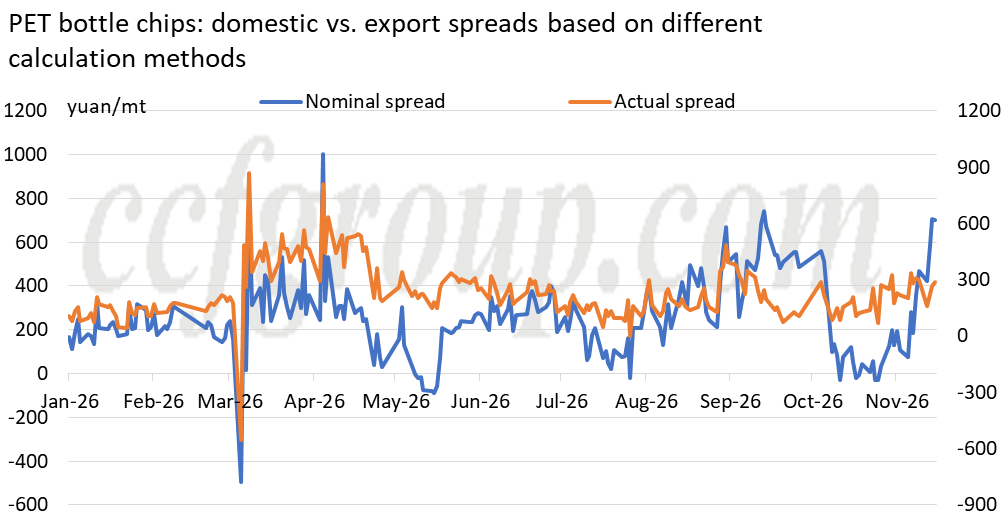
Note:
Nominal spread = FOB price × exchange rate – RMB price (excluding intermediate costs).
Actual spread = FOB price converted to RMB ex-works price – RMB ex-works price (accounting for intermediate costs and other factors, avoiding anomalies caused by feedstock premiums/discounts).
Therefore, the most appropriate way to compare the current spot domestic-export price spread for PET bottle chips is to convert the USD FOB export price into an RMB ex-works price, avoiding anomalies in the domestic-export feedstock price spread. Most of the time, market analysis cannot rely solely on numerical changes; one must also consider whether the comparison is being made under equivalent conditions and whether it is appropriate.