

Methanol: weak demand, difficult to rally |
|
| Louis | |
| Insight | Time: Nov 20 2026 3:42PM | |
Recently, China's methanol futures market has been range bound and weak, with pressure mainly coming from energy and its own demand side.
Externally, Middle East crude oil shipping volumes have increased, China domestic gasoline and diesel demand expectations are weak, and energy and chemical products as a whole are trending lower, making it difficult for methanol to gain sustained upward momentum.
On the demand side, the core issue is that profits cannot be passed downstream, and downstream users cannot absorb high-priced methanol. MTO units that purchase methanol externally have been mostly shut down. Olefin margins cannot be passed downstream, so downstream willingness to take feedstock at high prices naturally cannot improve.
Traditional downstream demand is declining as the year-end approaches, and weakening prices further suppress restocking demand, in the anticipation of buying later at low prices. As a result, demand for methanol is sluggish.
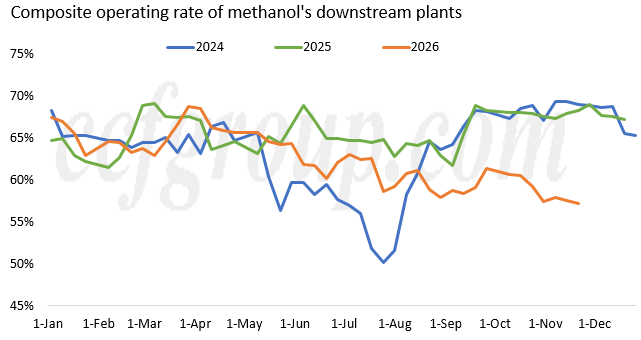
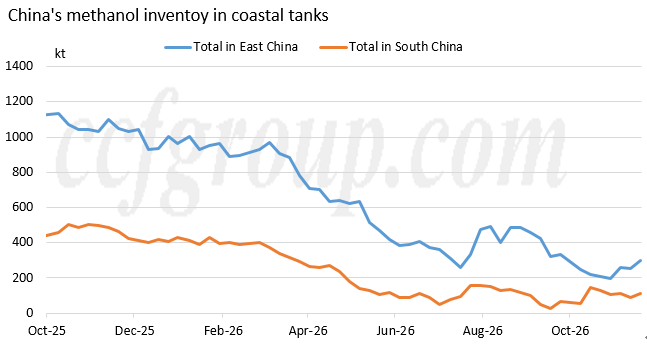
Recently, port inventories in East and South China have been accumulating. Some coastal MTO units are restocking and building inventory, and the circulation in public storage tanks is weak and can no longer support further destocking.
As for new capacity, China Coal Yulin's new methanol plant is expected to start up in December at year-end, but with an integrated MTO unit, its methanol is basically for captive use and has minimal impact on methanol supply-demand balance.
Inner Mongolia Rongxin's new standalone MTO unit may come on stream around the same time as Ningxia Baofeng Phase IV's methanol unit, with growth of supply and demand offsetting each other, and its impact on methanol dynamics will also be limited. Once Ningxia Baofeng Phase IV's own integrated MTO unit comes on stream, the positive effect of Rongxin's MTO unit may gradually emerge, but it may not happen until late Q1 next year.
However, if margins cannot be passed downstream, the timeline for Rongxin's new MTO unit could be uncertain. Therefore, new methanol and MTO capacity may not drag down or pull up methanol price substantially.
Under this circumstance, the possibility of methanol rising rests largely on a renewed US-Iran conflict, which would lift oil and energy prices and pull methanol up in tandem, rather than on its own fundamentals, because demand-supply is already at its worst.
On the fundamentals side, further export activity cannot be ruled out as support. But if the US-Iran standoff persists and the geopolitical premium gradually fades, methanol will return to its own logic of "high inventories, weak demand and poor margin transmission," and may continue to consolidate.