

Polyester industrial yarn: rising feedstock squeezes spread |
|
| Tina Kong | |
| Insight | Time: Sep 18 2026 9:38AM | |
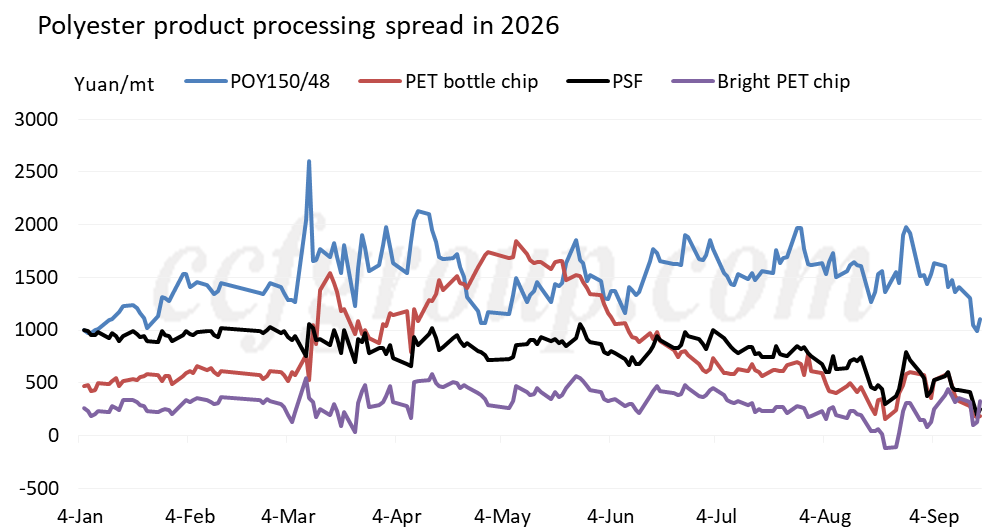
Recently, polyester feedstock costs have continued to climb sharply, while polyester product prices have failed to keep pace, significantly compressing processing spread. Immediate cash flow for polyester products is now in loss territory almost across the board, including textile filament yarn, staple fiber, PET fiber chip, and PET bottle chip. Among these, PET fiber chip suffered particularly severe losses in August, at one point even posting a negative processing spread. In early-September, as industry-wide production cuts and price support efforts intensified, processing spread recovered, but it was compressed again this week, with immediate cash flow losses currently substantial.
In September, PIY price increases also lagged behind feedstock costs, with processing spread trending lower amid volatility. In particular, while feedstock costs rose sharply this week, PIY prices held steady from Monday to Wednesday, significantly compressing processing spread. Although the segment has not yet entered loss territory, profit margins have narrowed considerably. On Wednesday this week, mainstream PIY producers jointly held prices steady while taking orders and announced plans to raise prices by 300 yuan/mt on Thursday. However, downstream purchasing momentum proved insufficient. It is understood that downstream mills with orders followed up modestly on feedstock replenishment, while those without orders were reluctant to speculate and chase high-priced restocking, fearing severe future inventory depreciation, with some downstream customers indicating plans for production cuts or shutdowns. As a result, PIY market trading sentiment was generally subdued on Wednesday.
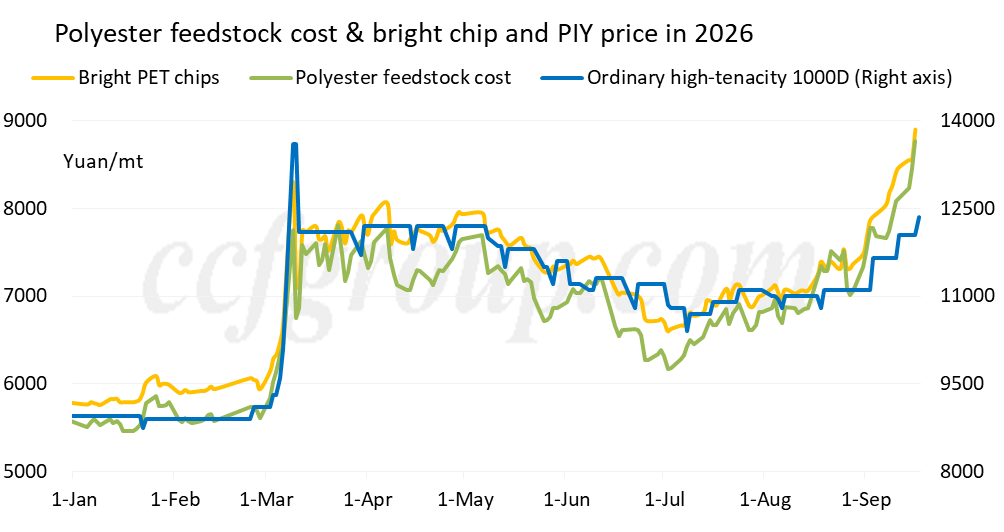
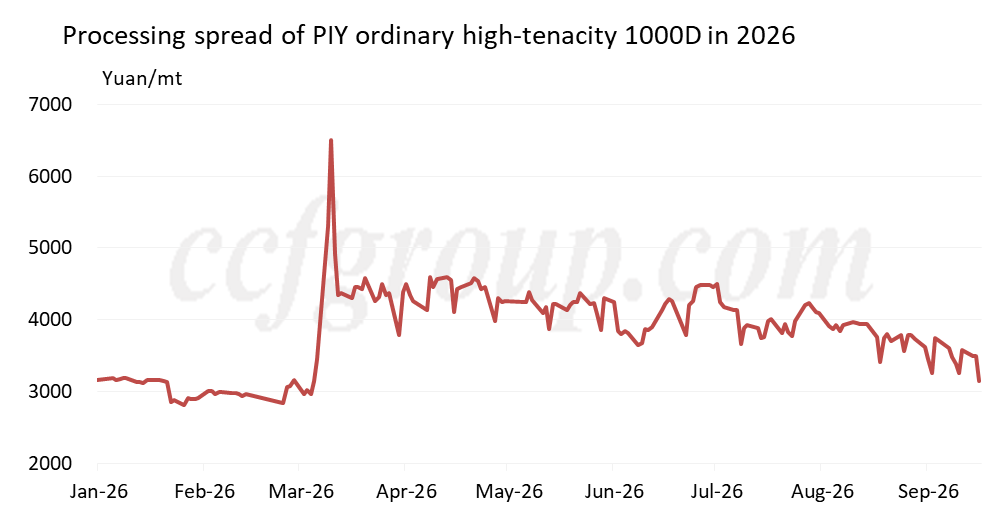
On September 17, mainstream domestic PIY prices rose by 300yuan/mt, with ordinary high-tenacity 1000D quoted at 12,400yuan/mt cash ex-works. Processing spread is expected to recover moderately but remains at relatively low levels compared with recent months.
PIY profitability has been generally strong this year, particularly in Q2. Based on current conditions, Q3 PIY profitability is expected to decline notably on a quarter-on-quarter basis.
| Quarterly average processing spread for chip-spun PIY ordinary high-tenacity 1000D (Unit: yuan/mt) | ||||
Quarter |
2025 |
2026 |
YoY |
QoQ |
Q1 |
2,443 |
3,482 |
+43% |
- |
Q2 |
2,737 |
4,218 |
+54% |
+21% |
Q3 |
2,896 |
3,816 |
+32% |
-10% |
Note: 2026 Q3 data is as of September 16.
Financial reports from listed companies primarily engaged in PIY business also reflected that Q2 profitability was notably better than Q1 this year. Hailide and Unifull both posted decent profits in Q2, while Sanwei's net loss was mainly attributable to losses in its BDO business.
However, in Q1 this year, according to data from CCFGroup, processing spread widened notably year-on-year, but actual PIY enterprise profitability declined year-on-year. This was because in March this year, affected by Middle East tensions, polyester chain prices rose sharply and PIY processing spread widened, but actual high-priced transactions were scarce. Instead, many earlier low-priced orders were shorted, and if feedstock costs were not locked in at low levels in a timely manner, a large discrepancy emerged between actual profitability and processing spread.
| Net profit of listed companies in the PIY industry and YoY/QoQ changes | ||||||||||
Company |
Q1 2025 (10,000 Yuan) |
Q1 2026 (10,000 Yuan) |
Q1 YOY |
Q2 2025 (10,000 Yuan) |
Q2 2026 (10,000 Yuan) |
Q2 YOY |
Q2 VS Q1 |
H1 2025 (10,000 Yuan) |
H1 2026 (10,000 Yuan) |
H1 YOY |
Hailide |
13969 |
12314 |
-11.85% |
15646 |
17232 |
10.14% |
39.94% |
29615 |
29546 |
-0.23% |
Sanwei |
2516 |
-11708 |
-565.40% |
-4379 |
-6858 |
56.62% |
41.42% |
-1863 |
-18566 |
/ |
Unifull |
527 |
-2005 |
-480.25% |
663 |
2800 |
322.21% |
239.63% |
1191 |
795 |
-33.24% |