

Middle East tensions spark PP price surge |
|
| Amber | |
| Insight | Time: Sep 10 2026 2:43PM | |
In the first week of September, renewed conflict between the US and Iran ignited the first rally in the chemical sector for the month. PP followed suit, with cumulative weekly gains of around 300 yuan/mt. As of last Friday (Sep 4), PP raffia was quoted at 9,500-9,650 yuan/mt in North China, 9,550-9,700 yuan/mt in East China, and 9,600-9,750 yuan/mt in South China.
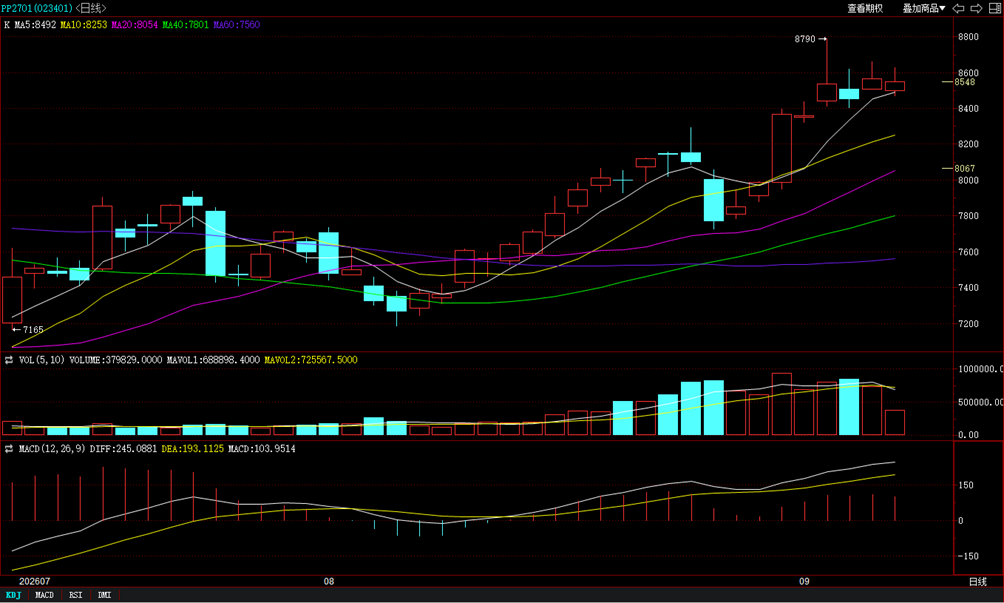
Specifically, the escalation of US-Iran tensions acted as the trigger, setting off a chain reaction across sentiment, costs, and supply.
First, the renewed escalation of US-Iran conflict directly pushed up crude oil prices, increasing the cost of oil-based PP production routes and providing strong support for spot price gains. In addition, higher crude prices further drove up chemical futures (including PP), boosting market sentiment and reinforcing spot prices.
Feedstock |
Weekly Average Price |
Change |
|
Overseas |
Naphtha-CFR Japan ($/mt) |
856.8 |
5.13% |
Propane-CFR Japan ($/mt) |
822 |
6.04% |
|
Propylene-CFR China ($/mt) |
1150 |
4.55% |
|
Domestic |
Methanol-Taicang, East China(yuan/mt) |
3278 |
12.49% |
Propylene-Shandong(yuan/mt) |
9310 |
5.74% |
|
Second, beyond crude oil itself, the escalation of US-Iran tensions and the blockade of the Strait of Hormuz also buoyed the energy market, with prices of PP feedstocks such as methanol, propane, and propylene rising notably. This similarly pushed up costs for PP production via purchased methanol, propane dehydrogenation (PDH), and purchased propylene routes. Among them, the largest increase among these feedstocks was domestic methanol, up around 12.5%, which led some domestic MTO units to shut down or cut rates, such as Tianjin Bohai Chemical and Shandong Levima. Other feedstocks rose by around 5-6%. Relative to feedstock gains, homo PP raffia prices rose only about 3.3%.
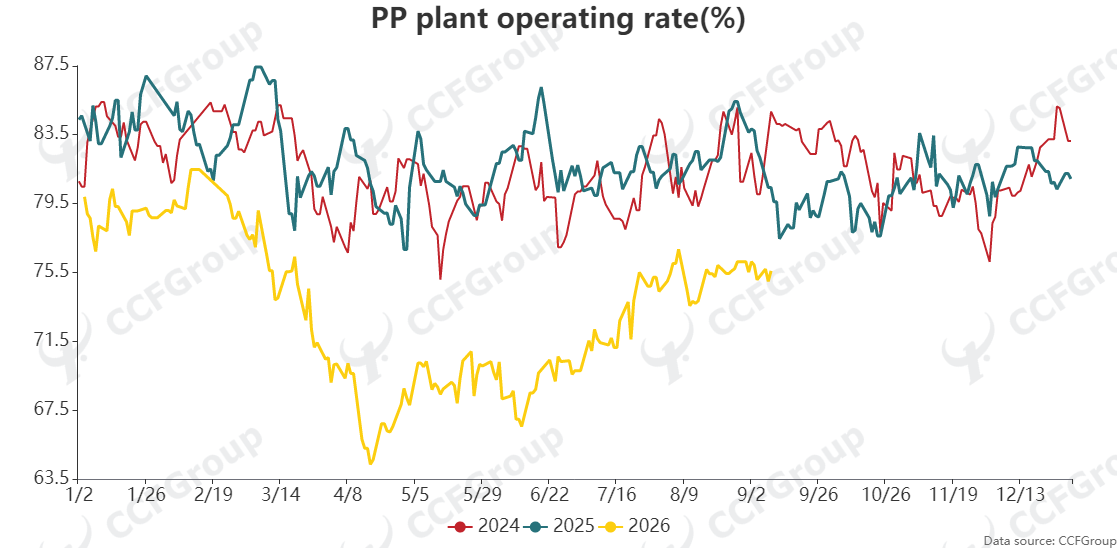
Finally, on the supply side. As PP spot price gains lagged those of feedstocks, profitability across most PP production routes deteriorated further. This caused the restart of previously shut-down units to be postponed, with timing yet to be determined, and high costs may also prompt some units to shut down temporarily. All of this limits the recovery in industry operating rates. Currently, China's PP operating rate is around 75%, 5-7 percentage points below previous years. In the short term, supply-side conditions are unlikely to ease effectively, which is a major factor supporting spot price gains.
As for demand, there has still been no improvement. Although an increase is expected, uncertainty remains, especially given that current feedstock prices are high, up over 50% from end-2025 levels.
In summary, the US-Iran situation remains the most core event affecting the PP market, triggering a series of chain reactions. In the short term, geopolitical conflicts remain volatile and warrant continued attention. Spot supply is tight, supporting the market at elevated levels. With the peak season approaching, downstream demand can be expected to improve somewhat, but expectations should not be set too high.