Shanghai Yarn Expo: Functional and green iterations of polyester filament yarn |
|
| Tina Kong | |
| Insight | Time: Aug 28 2026 3:38PM | |
On August 25, the China International Textile Yarn (Autumn & Winter) Exhibition opened at Hall 8.2 of the National Exhibition and Convention Center (Shanghai). This edition continued to be held concurrently with Intertextile Fabric Fair, CHIC Clothing Expo, and PH Value Knitting Expo. From upstream raw materials such as filament yarns and spun yarns to midstream fabrics and downstream finished garments, visitors could gain a comprehensive view of the industry chain's development and fashion trends.
In terms of polyester filament yarn exhibits, the main focus was on green, eco-friendly and functional iterations.
Currently, companies are primarily concentrating on three areas: multi-functional blended fibers, structurally shaped fibers (profiled hollow fibers), and composite spinning technologies.
Multi-functional integration is the main approach in differential fiber iteration. Previously, mainstream polyester differential fibers had already achieved full functional coverage; thus, the new iteration process is essentially one of multi-functional integration. Two or more functions-such as moisture-wicking, wrinkle resistance, UV protection, flame retardancy, anti-transparency/no-trace effects, and lightweight properties-are now realized on a single fiber. These multi-functions are primarily achieved through combinations of different additives, varied fiber structures, and changes in single-fiber cross-section.
Among these, a super-dull no-trace fiber appeared at multiple booths. By simply adjusting the ratio of matting agents, the previously ordinary dull fiber has gained a new property (water-drop no-trace). Some companies have further combined this with multi-component raw materials and structural changes (sheath-core type), adding advantages in reducing equipment damage.
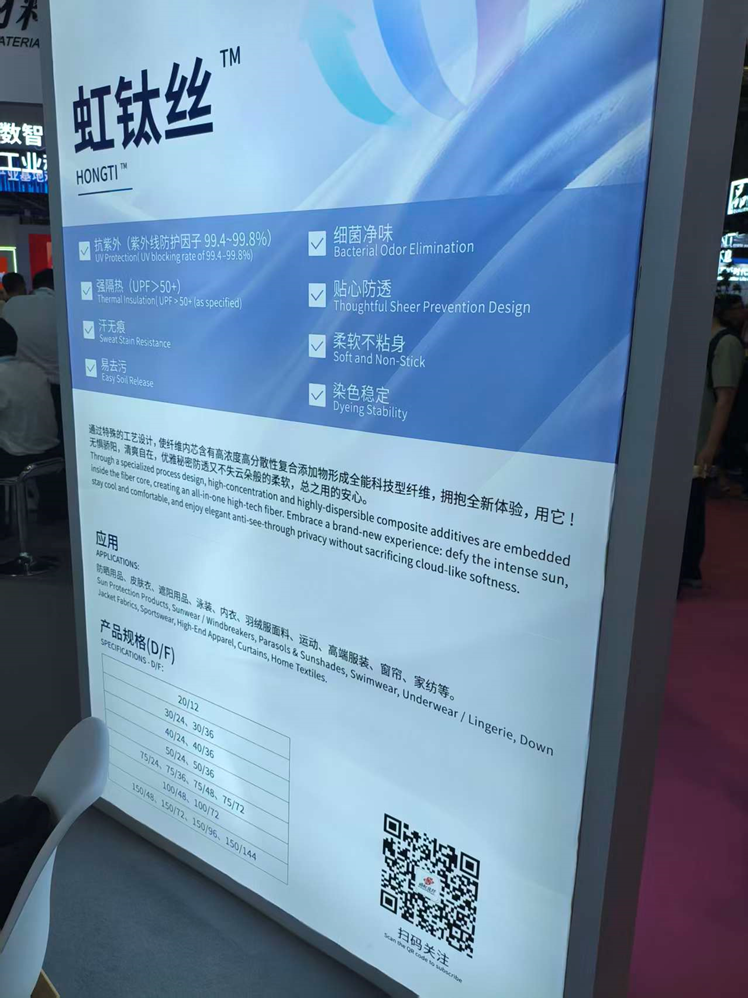
Additionally, compared with other functional realizations, temperature-related functional terms such as temperature control/regulation, cooling sensation, heat generation, and heat retention/thermal storage appeared frequently among the fiber functions displayed this year. This also represents one of the main development directions for future smart fibers.
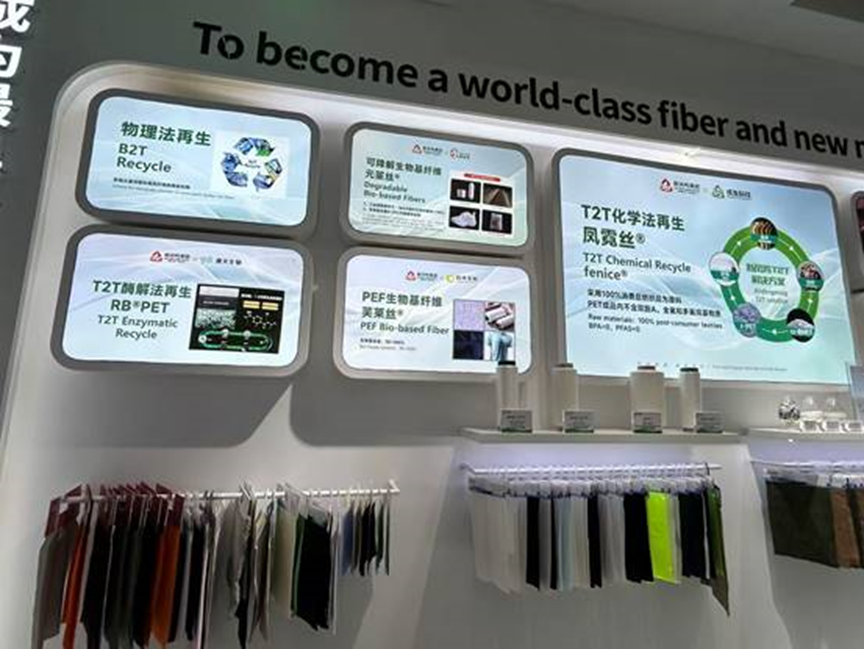
The schematic diagrams and product layout at the Xinfengming booth largely encompassed the main categories and iteration relationships of green eco-friendly fibers currently available.
1. Physical recycled polyester fiber (B2T): A previously common production approach, where the process changes only the physical form without breaking the PET molecular chain.
2. Chemical recycled polyester fiber (T2T): A supplement to the earlier physical recycling method, but with significantly fewer production facilities due to higher costs. This process chemically breaks ester bonds to obtain monomers/oligomers, which are purified and then repolymerized into PET polymer for spinning.
3. Enzymatic recycled polyester fiber (T2T): A new recycling approach. At this exhibition, multiple companies began promoting production varieties using this method, with a few companies launching new products based on it. This method primarily relies on bio-enzymes to directionally hydrolyze PET ester bonds, yielding monomers PTA and MEG, which are purified and then repolymerized for spinning. According to introductions from some factories, enzymatic recycling operates at lower reaction temperatures compared to chemical methods, thus consuming less energy.
4. Biodegradable bio-based fiber: By introducing specific hetero-atoms into the polyester molecular backbone/side chains and fiber matrix, and relying on the electronic effects, coordination, redox reactions, and acid-base catalysis of the elements themselves, this approach actively regulates ester bond hydrolysis-enzymatic cleavage behavior. It achieves a fiber design theory that ensures stable performance during use and controlled degradation after disposal. Unlike traditional fully hydrocarbon-oxygen polyesters, this approach does not rely solely on copolymerized aliphatic segments but uses the specific elements themselves as degradation switches and catalytic sites, enabling coexistence of fiber mechanical properties, spinning processability, and degradation rate.
5. PEF bio-based fiber (furan polyester): Also one of the main fibers promoted by companies in recent years. Its raw materials are 2,5-furandicarboxylic acid (FDCA) and MEG. FDCA is derived from non-grain biomass such as straw, corncobs, and bagasse, replacing petroleum-based PTA.